
DataTwin Seminar Highlights the Role of Data Spaces for AI-Driven Business Growth
On April 22, as part of the international forum “AI-Driven Growth: Scaling Business Internationally in the AI Era” at Sofia Tech Park, the DataTwin project hosted a dedicated seminar on enhancing stakeholder engagement and public-private collaboration, with a focus on “AI-Ready Urban Digital Twin for Competitive Advantage.” The session placed strong emphasis on data spaces as a key driver for innovation and business development in the AI era. The event brought together leading experts and organizations exploring how artificial intelligence supports international growth. As a co-organizer, the GATE Institute contributed its expertise in big data, AI, and urban digital twins, positioning data spaces at the center of emerging digital ecosystems.
4/28/20262 min read
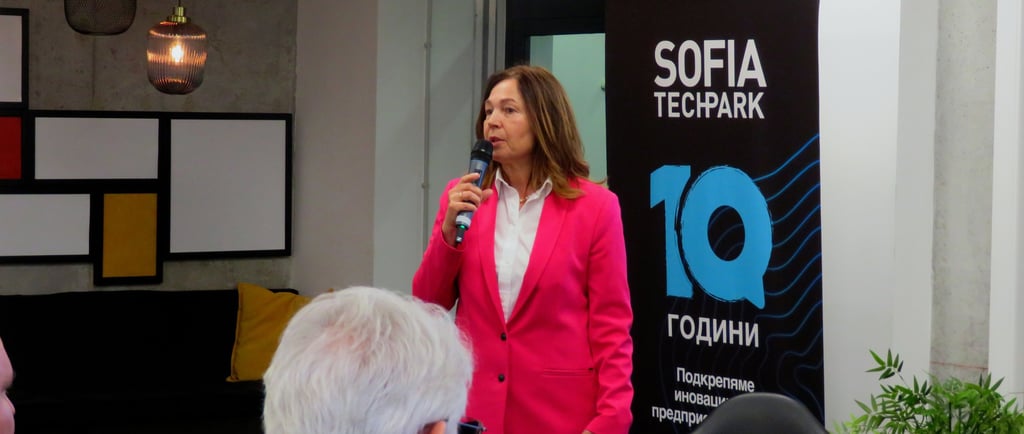
On April 22, as part of the international forum “AI-Driven Growth: Scaling Business Internationally in the AI Era” at Sofia Tech Park, the DataTwin project hosted a dedicated seminar on enhancing stakeholder engagement and public-private collaboration, with a focus on “AI-Ready Urban Digital Twin for Competitive Advantage.” The session placed strong emphasis on data spaces as a key driver for innovation and business development in the AI era.
The event brought together leading experts and organizations exploring how artificial intelligence supports international growth. As a co-organizer, the GATE Institute contributed its expertise in big data, AI, and urban digital twins, positioning data spaces at the center of emerging digital ecosystems.
During the seminar, Prof. Sylvia Ilieva, Director of GATE, highlighted that the next phase of digital transformation is not defined by data ownership, but by the ability to operate within trusted, interoperable data spaces. These environments enable secure data sharing across sectors, unlocking new opportunities for innovation, services, and cross-border business expansion.
“Today, value is no longer created in isolation — it is built together,” Prof. Ilieva emphasized, pointing to data spaces as the foundation for collaborative value creation between public institutions, private companies, and research organizations.
The discussion demonstrated how AI-ready urban digital twins, powered by integrated data spaces, can support both public governance and private sector growth. By combining real-time data, advanced analytics, and simulation capabilities, such platforms allow businesses to develop new services, optimize operations, and scale solutions internationally.
Special attention was given to the role of data ecosystems in enabling public-private partnerships, where stakeholders contribute and access data through trusted frameworks ensuring transparency, security, and sovereignty. Participants explored how these models can accelerate innovation cycles, reduce market entry barriers, and foster new business models based on data-driven services.
The ongoing development of the Digital Twin of Sofia by GATE was presented as a practical example of how data spaces can be implemented to support urban planning, mobility, sustainability, and economic development—while also creating opportunities for companies to build and test AI-powered solutions.
The broader event, organized by the Norwegian-Bulgarian Chamber of Commerce, Bulgarian AI Cluster, Sofia Tech Park, Cluster for Applied AI Norway, BASSCOM, and BAIT, provided a platform for sharing best practices in AI-driven growth. Within this context, the DataTwin seminar underscored a key message: future competitiveness will depend on participation in data spaces that connect technology, business, and public value creation.